Wukang Road & Wukang Mansion (French Concession)
Taxi & Street Navigation Help
师傅,请带我去徐汇区淮海中路【武康大楼】(淮海中路1850号),请在武康路路口方便停车处停靠,谢谢!
Opening Hours & Best Time
Open 24/7 (Boutiques & cafes open ~10:00 - 22:00)
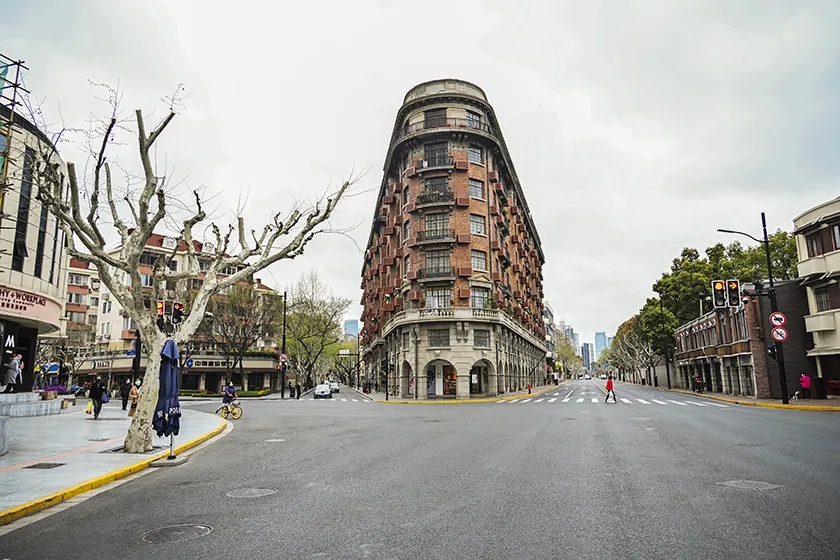
💡 Pro Tip: Stand on the designated pedestrian traffic island directly opposite the sharp corner of Wukang Mansion for the legendary flatiron photo angle. Rent a shared bicycle to cruise down the London plane tree canopy early in the morning.
Accessibility & Luggage Lockers
Accessibility: ♿ Wheelchair & Stroller Friendly
Flat asphalt sidewalk lanes with dropped curbs at road crossings. Very welcoming for casual walking and cycling.
🧳 Luggage Storage: Recommended to leave luggage at central hotel or nearby Shanghai Library Metro Station.
Nearby Iconic Landmarks & Walking Connections
Easily combine your itinerary with these neighboring architectural landmarks and cultural points of interest:
About Wukang Road & Wukang Mansion (French Concession)
1. The Architect’s Escape: László Hudec’s Survival Epic
The story of Wukang Mansion is inseparable from the incredible life of its architect, László Hudec (1893–1958). Born in modern-day Slovakia to a Hungarian-Slovak family, Hudec was drafted into the Austro-Hungarian army during World War I and captured by the Russian military in Siberia.
Facing likely death in a remote prison camp, Hudec orchestrated a daring escape by leaping from a moving prisoner-of-war train in the dead of winter. Traveling through frozen Siberia with false identity papers, he eventually arrived penniless in cosmopolitan Shanghai in 1918.
Within a decade, this penniless escaped prisoner of war established himself as Shanghai’s most visionary private architect. He would go on to shape over 60 defining skyline masterworks—including the Park Hotel (Asia’s tallest skyscraper for over four decades) and the Grand Theatre.
2. Architectural Marvel: The 30-Degree Wedge
Completed in 1924, the building was originally named the Normandie Apartments (in honor of the French battleship Normandie).
Faced with a challenging, awkward 30-degree acute triangular intersection where Avenue Joffre (now Huaihai Middle Road) met Route Ferguson (now Wukang Road), Hudec turned a spatial crisis into an architectural masterpiece:
- The Flatiron Bow: He modeled the 8-story red-brick building like a colossal French Renaissance ocean liner steaming directly into the intersection.
- Corinthian Pilasters & Red-Brick Warmth: The lower two floors are wrapped in classical rusticated limestone arcades, while the upper six stories feature dark red face-brickwork accented with ornamental spiral fire-escape balconies and elaborate roof cornices.
3. Cradle of China’s Golden Era of Cinema (1930s–1950s)
During the mid-20th century, Wukang Mansion became the bohemian residential colony for China’s brightest literary figures, playwrights, and silver-screen superstars:
- “The Golden Voice” Zhou Xuan (周璇): One of China’s most celebrated vocalists and screen sirens lived in Room 306.
- Master Actor Zhao Dan (赵丹): The leading man of classic cinematic masterpieces like Street Angel (马路天使, 1937) and Crossroads occupied an apartment here during the height of Shanghai’s golden cinematic era.
4. The Legend of the “French Concession Plane Trees”
Stretching outward from the mansion is Wukang Road, often hailed as an “Outdoor Architectural Museum”. Shading the entire avenue is a dense cathedral-like green canopy of overhanging trees.
- The Historical Trivia: Locals refer to these trees as “Faguo Wutong” (法国梧桐, French Plane Trees). In the early 20th century, the governing French Municipal Council imported thousands of London Plane trees (Platanus × acerifolia) via the French port of Marseille to recreate Parisian boulevard charms in Shanghai. Over a century later, their dappled shadows, falling golden autumn leaves, and peeling bark remain the definitive aesthetic soul of old romantic Shanghai.